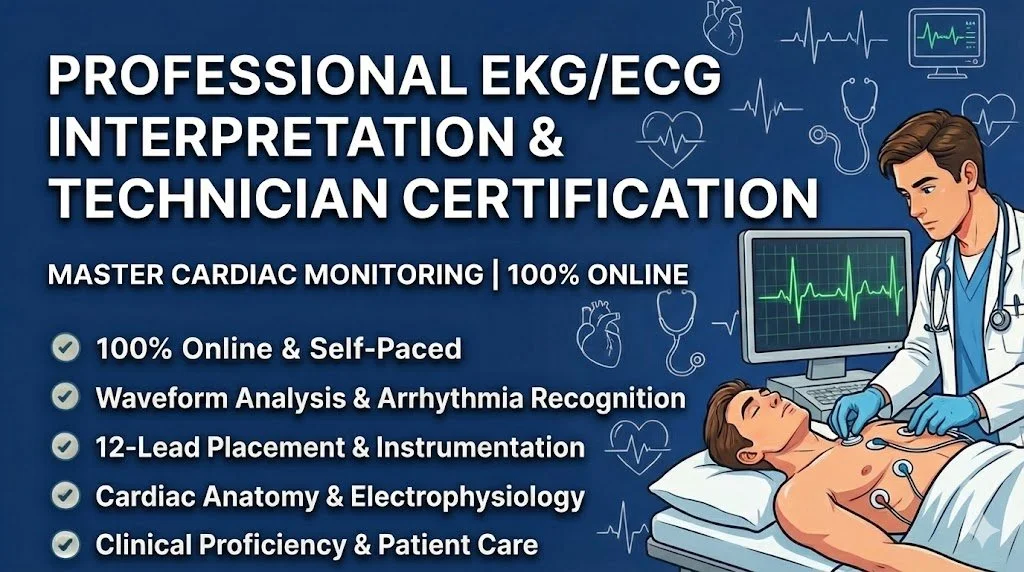
1.1 Overview of the EKG Technician Profession
An Electrocardiogram (EKG or ECG) Technician is a specialized allied healthcare professional responsible for performing diagnostic procedures that record the electrical activity of the heart. These recordings provide critical information used by licensed healthcare providers to assess cardiac function, identify abnormalities, monitor disease progression, and guide treatment decisions. While EKG technicians do not diagnose medical conditions or prescribe treatment, their technical accuracy and procedural competence directly influence the reliability of cardiac assessments and, ultimately, patient outcomes.
The role of the EKG technician exists at the intersection of technology, patient care, and clinical workflow. Technicians must operate sophisticated medical equipment while maintaining clear communication with patients who may be anxious, in pain, or experiencing acute cardiac symptoms. This dual responsibility requires not only technical skill, but also professionalism, empathy, and strict adherence to clinical protocols.
As healthcare systems increasingly rely on diagnostic testing to support evidence-based medicine, the demand for skilled EKG technicians continues to grow across hospitals, outpatient clinics, specialty cardiology practices, and long-term monitoring environments.
1.2 Primary Functions and Responsibilities
The core function of the EKG technician is to obtain accurate, high-quality electrocardiographic recordings. This responsibility encompasses multiple steps that must be executed precisely to ensure valid results.
Before the test begins, the technician is responsible for confirming patient identity using approved identifiers, reviewing test orders, and explaining the procedure in clear, non-technical language. This explanation helps reduce patient anxiety and promotes cooperation, which is essential for minimizing movement artifacts and obtaining clean tracings.
During the procedure, the technician prepares the patient’s skin, applies electrodes using standardized anatomical landmarks, connects lead wires correctly, and verifies proper machine settings. Attention to detail is critical, as improper lead placement or poor skin preparation can produce false abnormalities that mimic serious cardiac conditions.
After obtaining the EKG, the technician ensures that the recording is legible, complete, properly labeled, and documented according to facility policies. In urgent or emergent situations, the technician may be required to promptly deliver the tracing to clinical staff or upload results to an electronic health record system for immediate review.
1.3 Scope of Practice Defined
Scope of practice refers to the tasks and responsibilities a professional is legally and ethically permitted to perform based on education, training, certification, and regulatory guidelines. For EKG technicians, scope of practice is clearly defined and intentionally limited to protect patient safety and ensure appropriate clinical oversight.
Within their scope, EKG technicians are authorized to perform diagnostic cardiac monitoring procedures such as resting 12-lead EKGs, rhythm strips, telemetry monitoring, and, in some settings, ambulatory monitoring such as Holter or event monitors. Technicians may also assist with stress testing procedures or continuous cardiac monitoring under supervision, depending on employer policies and training.
EKG technicians are not authorized to interpret EKGs diagnostically, determine medical significance, communicate diagnoses to patients, or initiate treatment. Interpretation and clinical decision-making fall exclusively under the responsibility of licensed healthcare providers such as physicians, nurse practitioners, or physician assistants. Any observation of concerning findings must be escalated appropriately rather than analyzed independently.
Understanding and respecting scope of practice is essential for legal compliance, professional credibility, and patient safety.
1.4 Legal and Regulatory Boundaries
EKG technicians practice within a framework of institutional policies, state regulations, and federal healthcare laws. Although requirements vary by jurisdiction, most healthcare facilities require formal training, competency verification, and adherence to standardized operating procedures.
Practicing outside one’s authorized scope can result in serious consequences, including disciplinary action, termination of employment, loss of certification eligibility, or legal liability. For this reason, EKG technicians must maintain clear role boundaries and avoid offering interpretations, advice, or reassurance that could be construed as medical judgment.
Regulatory compliance also includes accurate documentation, proper patient identification, and adherence to privacy laws such as the Health Insurance Portability and Accountability Act (HIPAA). These regulations govern how patient data is collected, stored, shared, and protected.
1.5 Clinical Responsibilities vs Non-Clinical Duties
While EKG technicians are primarily clinical professionals, their role includes both direct patient care and supportive non-clinical responsibilities. Clinical responsibilities include patient preparation, electrode placement, equipment operation, and test execution. These tasks require hands-on skill and real-time decision-making to ensure accuracy.
Non-clinical duties may include cleaning and disinfecting equipment, restocking supplies, performing basic equipment checks, and reporting malfunctions. Technicians may also assist with scheduling, record management, and quality assurance activities that support efficient healthcare delivery.
These non-clinical responsibilities are not secondary; they are essential to maintaining a safe, compliant, and effective diagnostic environment.
1.6 Professional Accountability and Ethical Responsibility
Professional accountability means taking ownership of one’s performance and adhering to established standards of practice. EKG technicians are accountable for following protocols, maintaining competency, and ensuring that each test is performed with accuracy and integrity.
Ethical responsibility includes respecting patient dignity, maintaining confidentiality, and acting in the patient’s best interest at all times. Patients undergoing EKG testing may be vulnerable due to fear, pain, or uncertainty. The technician’s conduct should reflect compassion, patience, and professionalism.
When uncertainties arise or abnormal situations are encountered, ethical practice requires escalation to appropriate clinical staff rather than independent action beyond one’s role.
1.7 The EKG Technician as a Member of the Healthcare Team
EKG technicians function as integral members of interdisciplinary healthcare teams. Their work supports physicians, nurses, and other clinicians by providing reliable diagnostic data that informs patient care decisions.
Effective teamwork requires clear communication, respect for professional roles, and responsiveness to clinical needs. In high-acuity settings such as emergency departments or intensive care units, the technician’s efficiency and accuracy can directly impact clinical workflow and patient outcomes.
Understanding how one’s role fits into the larger healthcare system reinforces professional identity and promotes collaborative, patient-centered care.
1.8 Practical Role Application in Real-World Settings
Consider a scenario in which a patient presents to an emergency department with chest pain. The EKG technician is tasked with performing an immediate EKG. In this high-pressure environment, the technician must rapidly prepare the patient, apply leads accurately, and obtain a clean tracing despite distractions and patient distress.
The technician must recognize the urgency of the situation without attempting interpretation and ensure that results are delivered promptly to clinical staff. This scenario illustrates the importance of role clarity, scope adherence, technical competence, and professionalism in real-world practice.
 UKPRN 10092631